在「界」的邊緣凝視「無界」:王穆提《Unbounded》於日本國立新美術館展出,獲「日本透納賞」肯定 - WANG MUTI Exhibited at The National Art Center, Tokyo, Recognized with the Japan Turner Award
文章索引
第 2 頁,共 3 頁
Gazing at the “Unbounded” from the Edge of the “Bounded”: Wang Muti’s “Unbounded” Exhibited at The National Art Center, Japan, Receives the “Turner Award Japan”
Feature Report
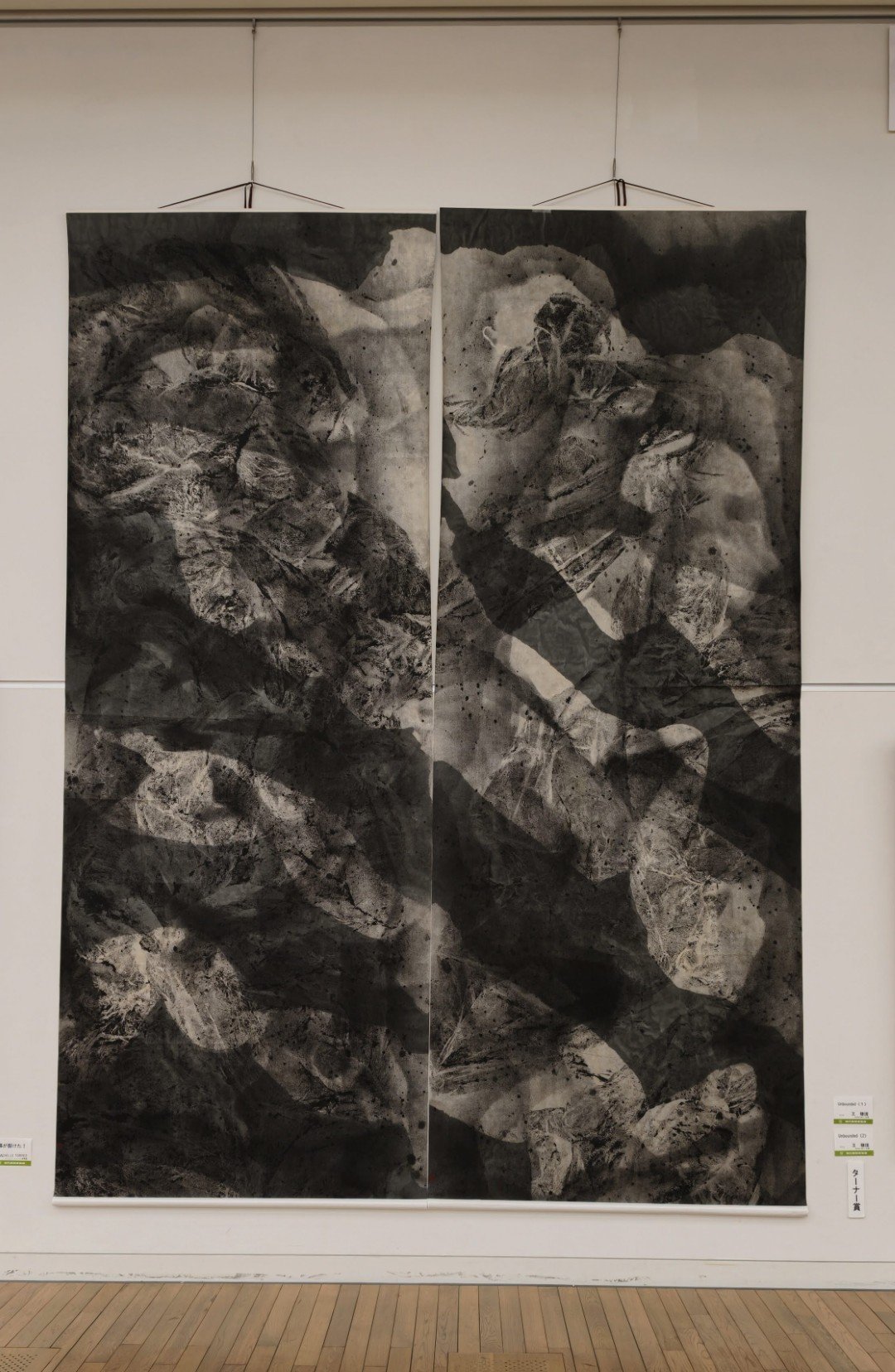
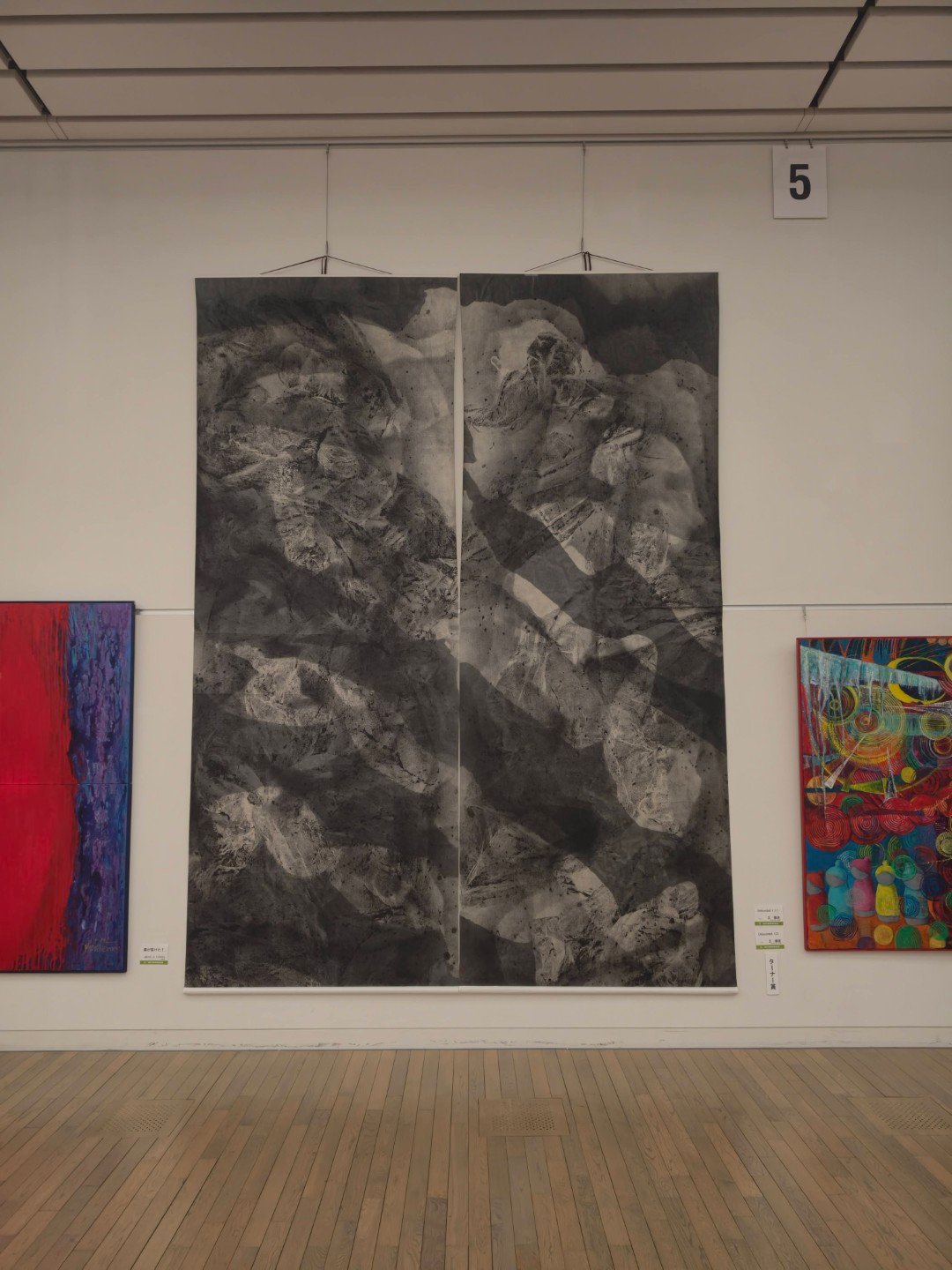
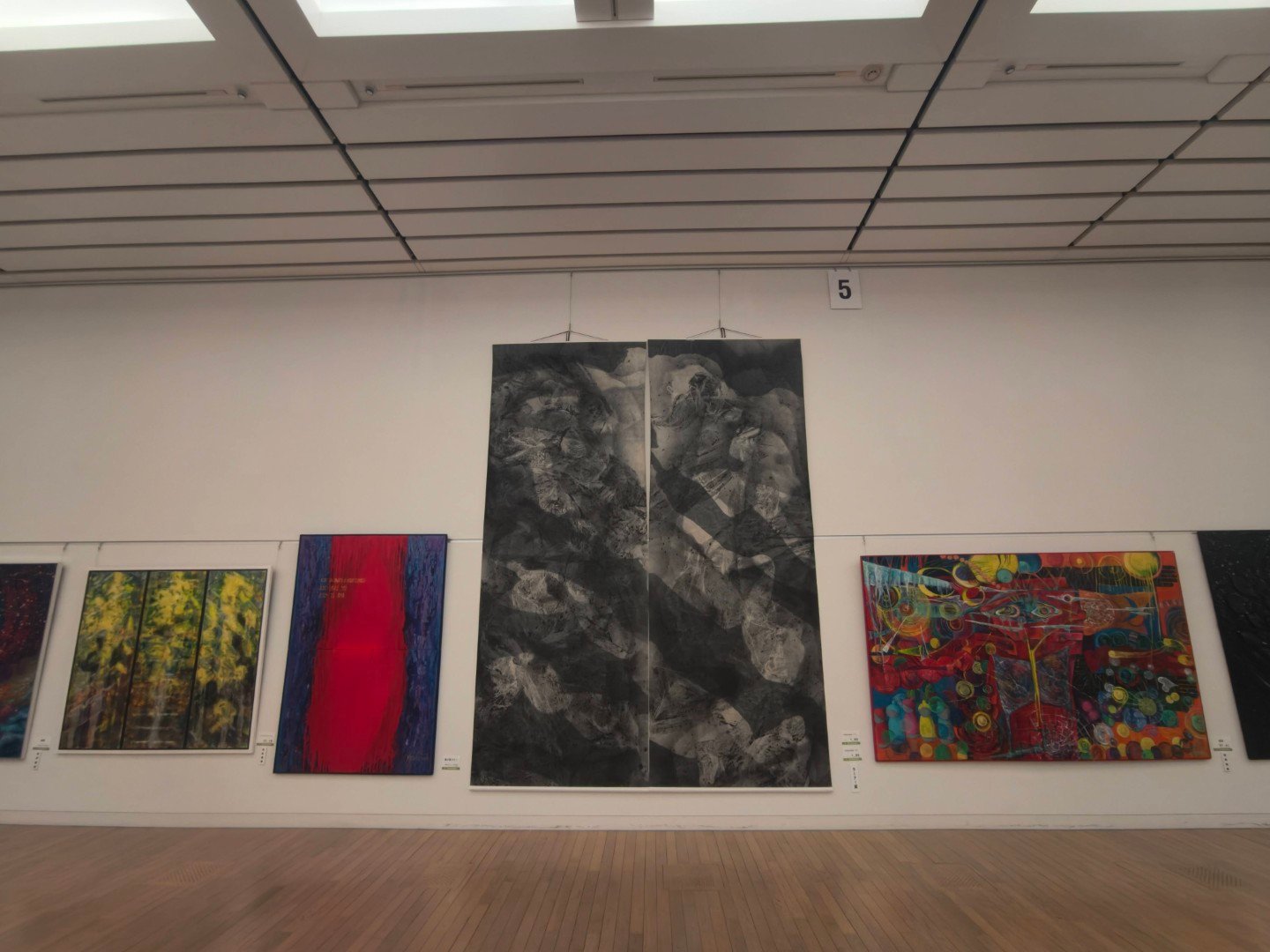
At The National Art Center, Japan, within the exhibition venue of the 82nd Japan Contemporary Art Exhibition (Genten), Taiwanese contemporary artist Wang Muti’s large-scale diptych Unbounded, with its nearly four-meter vertical scale, becomes an unmistakable visual focal point of the venue. The work, composed of natural plant dyes, Japanese ink, acrylic paint, and xuan paper, measures 387 cm in height and 291 cm in width. The two panels are hung side by side, resembling a torn dark canyon, or a spiritual map in the process of formation.
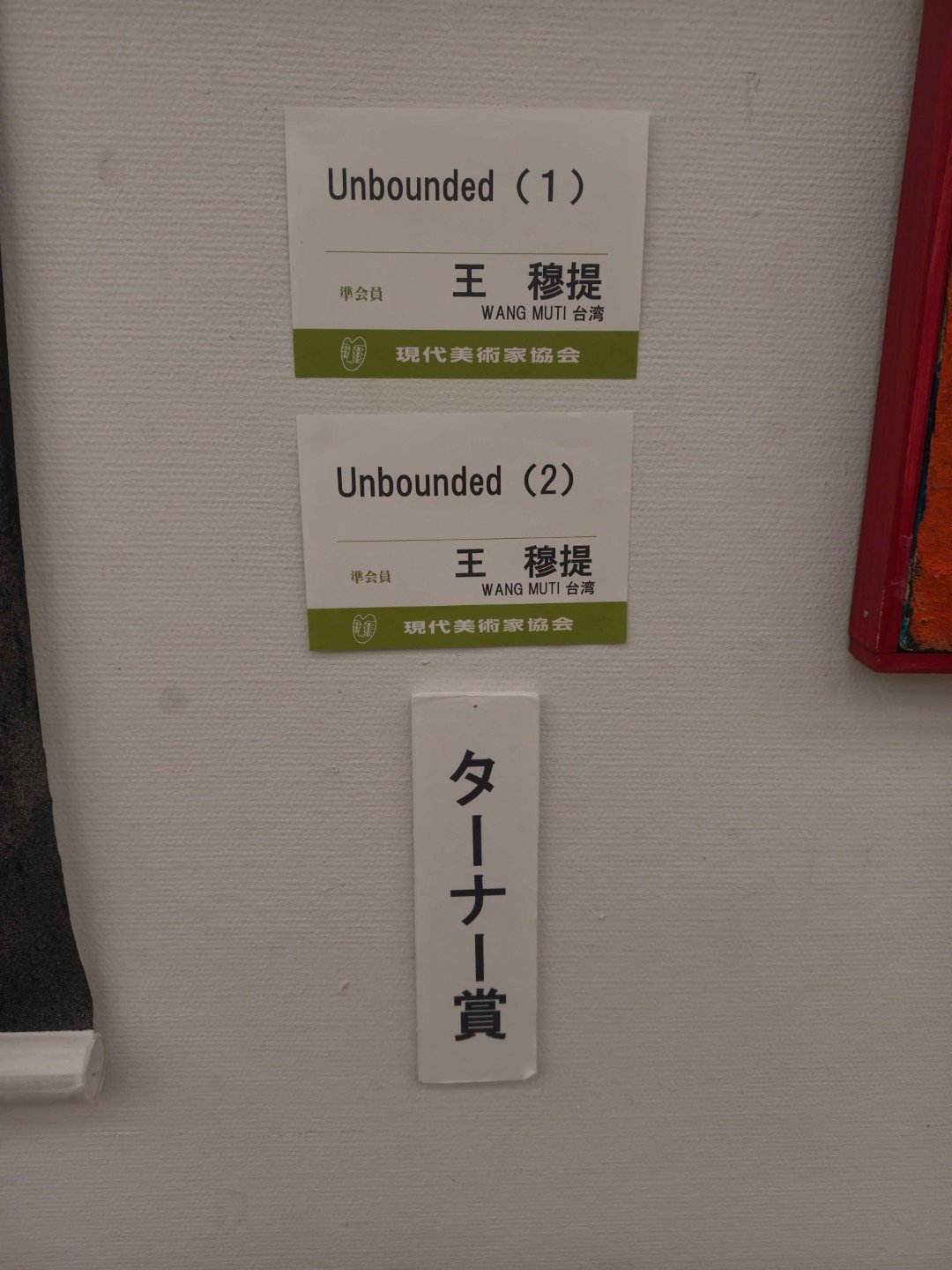
Unbounded has been recognized with the “Turner Award,” established by the renowned Japanese art materials company Turner Colour Works Ltd. (founded in 1946), and presented at the 82nd Japan Contemporary Art Exhibition held at The National Art Center, Japan. The award aims to encourage creators who demonstrate outstanding achievement in material mastery, color expression, and contemporary artistic language. At the same time, the artist has broken the record of the Japan Contemporary Art Exhibition by being recommended as an associate member after participating twice (within two years) (in 2025), whereas it typically takes more than four to seven years for participants in Japanese open-call exhibition organizations to reach the associate membership stage.
Monumental Diptych: A Confrontation Between Ink and Geometry
The most immediate impact of Unbounded comes from its almost architectural scale. When the two pieces are placed together, they form a vertically unfolding deep black space. Standing before the work, it is difficult for viewers to grasp the whole at once; the gaze moves repeatedly between the dense ink layers above, the drifting gray-white halos in the center, and the heavily accumulated black masses below.
On the surface of the image, multiple semi-transparent grayscale blocks with diagonal and straight-edged boundaries can be seen. These geometric forms resemble calm cross-sections, or observational lenses floating above chaos. At the same time, the underlying ink is not disciplined into a single image, but instead forms complex textures reminiscent of abysses, geological strata, and nebulae through layering, seepage, sedimentation, and diffusion.
This visual structure makes Unbounded not merely abstract ink painting, nor simply geometric painting. The core tension of the work lies precisely in the repeated pull between the “bounded” and the “unbounded”: on one hand, straight lines, frames, and rational order; on the other, flow, diffusion, and immeasurable undercurrents of ink.
From the “Bounded” to the “Unbounded”: The Spiritual Site of Contemporary Ink
In this work, Wang Muti does not rely on conspicuous physical textures or external masking effects to produce visual impact. Instead, the work is closer to a prolonged contemplation of the nature of ink itself: how moisture drives ink particles, how xuan paper fibers absorb pigment, and how time allows layers of color to gradually settle.
In traditional ink painting, brush and ink are often used to depict landscapes, flora, fauna, or figures; in Unbounded, however, ink no longer serves representation, but becomes the subject of the work. The flow, stasis, accumulation, and eruption of ink itself constitute the rhythm of life within the image. What the viewer sees is not a specific scene, but a process of material generation.
This mode of creation also gives the work a clear sense of contemporaneity. It retains the Eastern ink tradition’s sensitivity to vitality, time, and emptiness, while introducing a visual logic akin to Western hard-edge abstraction, minimalist structure, and spatial segmentation. These elements do not cancel each other out, but instead form a dialectical relationship on the same sheet of xuan paper.
The Rational Boundary: Drawing Hard Edges on a Soft Medium
One of the most compelling aspects of Unbounded is the seemingly calm and precise geometric boundaries within the image. Xuan paper and water-based media are inherently fluid; once ink or pigment seeps into the paper fibers, it easily produces diffusion, feathering, and irreversible marks. To maintain straight, angled, controlled edges on such a medium is not merely a matter of formal design, but the result of high technical skill and physical control.
These semi-transparent geometric blocks resemble a rational system intervening in chaos. They do not completely obscure the underlying ink traces, but allow the textures beneath to emerge faintly. As a result, the image produces a multilayered viewing experience: viewers can perceive both the rational framework and, through it, gaze into the unfathomable undercurrents below.
In this sense, the “bounded” in Unbounded is not a closed wall, but a temporarily established order; it both constrains the ink and allows it to be seen anew.
The Abyss of the “Unbounded”: Undercurrents of Life, Time, and the Subconscious
In contrast to the rational order represented by geometric structures, the large-scale ink accumulations in the image present an untamable “unbounded” force. Black, gray, and white intertwine continuously, forming composite images reminiscent of rock layers, clouds, storms, or bodily textures. They have no clear beginning nor definite end, as if they continue to extend beyond the edges of the picture.
This visual effect gives the work not only formal beauty but also psychological and philosophical depth. From the perspective of Buddhist Yogācāra thought, the underlying ink traces may be understood as the flow of seeds hidden deep within consciousness; from the perspective of modern society, they resemble life energy suppressed by rational systems, data structures, and constructed orders.
Unbounded can thus be seen as a spiritual portrait of contemporary humanity: in a highly regulated world, people continually construct order, yet must inevitably face the return of inner chaos.
The Genten Exhibition and the Turner Award: Recognition Within Japan’s Contemporary Art Field
The “Genten” exhibition, organized by the Japan Contemporary Artists Association, has long been an important platform for contemporary artists in Japan to present their works, encompassing diverse media such as painting, sculpture, crafts, and photography. The “Turner Award” within Genten is a corporate-sponsored prize supported by the renowned Japanese art materials brand Turner Colour Works Ltd.
Receiving this award signifies recognition from both exhibition jurors and a professional enterprise for excellence in material usage and contemporary expression. For Wang Muti, Unbounded, created through the interweaving of natural plant dyes, Japanese ink, acrylic paint, and xuan paper, responds directly to the Turner Award’s emphasis on material experimentation and color expression.
Conclusion: Re-understanding Ink Before the Abyss
Unbounded is not a work that provides comforting answers. It does not depict recognizable landscapes, nor does it allow the viewer to remain within decorative abstract aesthetics. Rather, it resembles a visual field in which rationality and chaos, control and flow, boundary and boundlessness continually confront one another across an immense sheet of xuan paper.
Through this diptych, Wang Muti liberates ink from the representational traditions of imagery, transforming it into a site where time, material, and spiritual forces intersect. Standing before Unbounded, the viewer faces not only the abyss of ink, but also a question about contemporary existence: in a world that feels out of control, how does one draw one’s own boundaries? And can those drawn boundaries truly restrain the unbounded flow within?